
Strategy · Guide · 5 MIN READ
Visibility on the Shop Floor: Why Digital Boards Often Fail
A mid-sized manufacturer swaps its magnetic planning board for tablets — and loses the feel for the floor. Why that happens and how you preserve visibility.
strukturunion Team · March 12, 2015
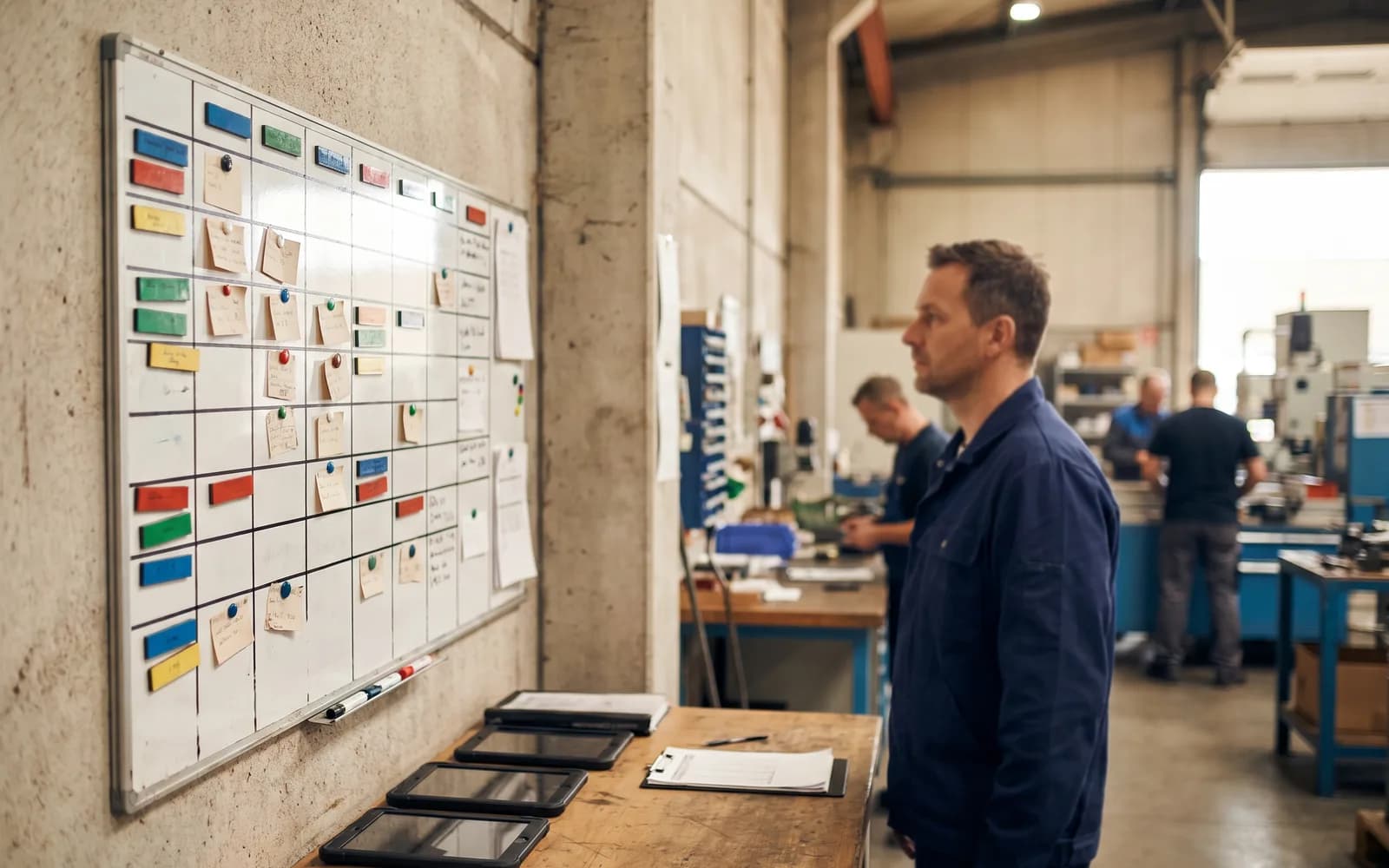
A mid-sized manufacturer replaces its magnetic T-card planning board with a modern, digital kanban system on individual tablets. After a few weeks, machine utilization has noticeably dropped, and the supervisors say they've "lost the eye for the floor." The technology works flawlessly — and yet production runs worse than before. This isn't an isolated case, it's a pattern we see again and again.
The pattern
Digital interfaces break information apart and arrange it into lists. On a tablet, an employee sees exactly the task in front of them or a summarized line of text — nothing more fits on the screen. A physical planning board, by contrast, has spatial volume and sensory presence. A dense block of red cards on the wall instantly creates a feeling of urgency, entirely without reading. A supervisor can look across a long hall and read from the geometric picture, in seconds, how the operation is doing.
When you digitize the tool without preserving this spatial legibility, you take away from the floor exactly the ambient awareness that keeps production flowing. Visibility isn't a detail of the interface — it was the actual purpose of the old board. The mistake rarely lies in the software, but in the assumption that a screen can simply replace a wall.
From our practice
Early in our consulting work we tried, ourselves, to replace a physical whiteboard with a standard installation of a ticket system — for an assembly line. It went thoroughly wrong. The line leads soon stopped looking at the metrics, because they had to click through tabs to see the overall picture. What was passively visible suddenly became active work.
From that we derived a clear rule: visibility must be passive, not active. No one should have to click to understand how the day is going. Since then we approach every digitization of a physical process differently:
- We use large, permanently running overview monitors above the floor, instead of distributing information only to individual devices.
- We map the geometry of the hall — the display follows the real layout, not an abstract list.
- We work with high contrast and few states, so that a glance from a distance is enough.
- Individual tablets stay in place for detail work, but never replace the big picture on the wall.
The decisive point: the team should grasp the state of production in passing, without stopping and typing. Only when the software achieves that has it really replaced the board — and not just reproduced it digitally.
Why this matters
The cost of a poorly introduced board doesn't show up on the invoice, but in lost responsiveness. A bottleneck that everyone used to see in passing now stays unnoticed until someone actively calls it up. It's exactly in this gap that delays accumulate. Preserve the spatial perception and you keep the reaction time short — that's the real gain.
Takeaway
Digital boards fail on the shop floor not for lack of features, but for lack of passive visibility. Whoever digitizes a physical tool must first understand which perception it unconsciously delivered, and translate that into the new solution. On every such project we go into the hall first, before writing a single line. If you're facing a similar switch, we're glad to look at your process together before the first board comes off the wall.