
CASE STUDY
Maintenance data from the field for plant engineering
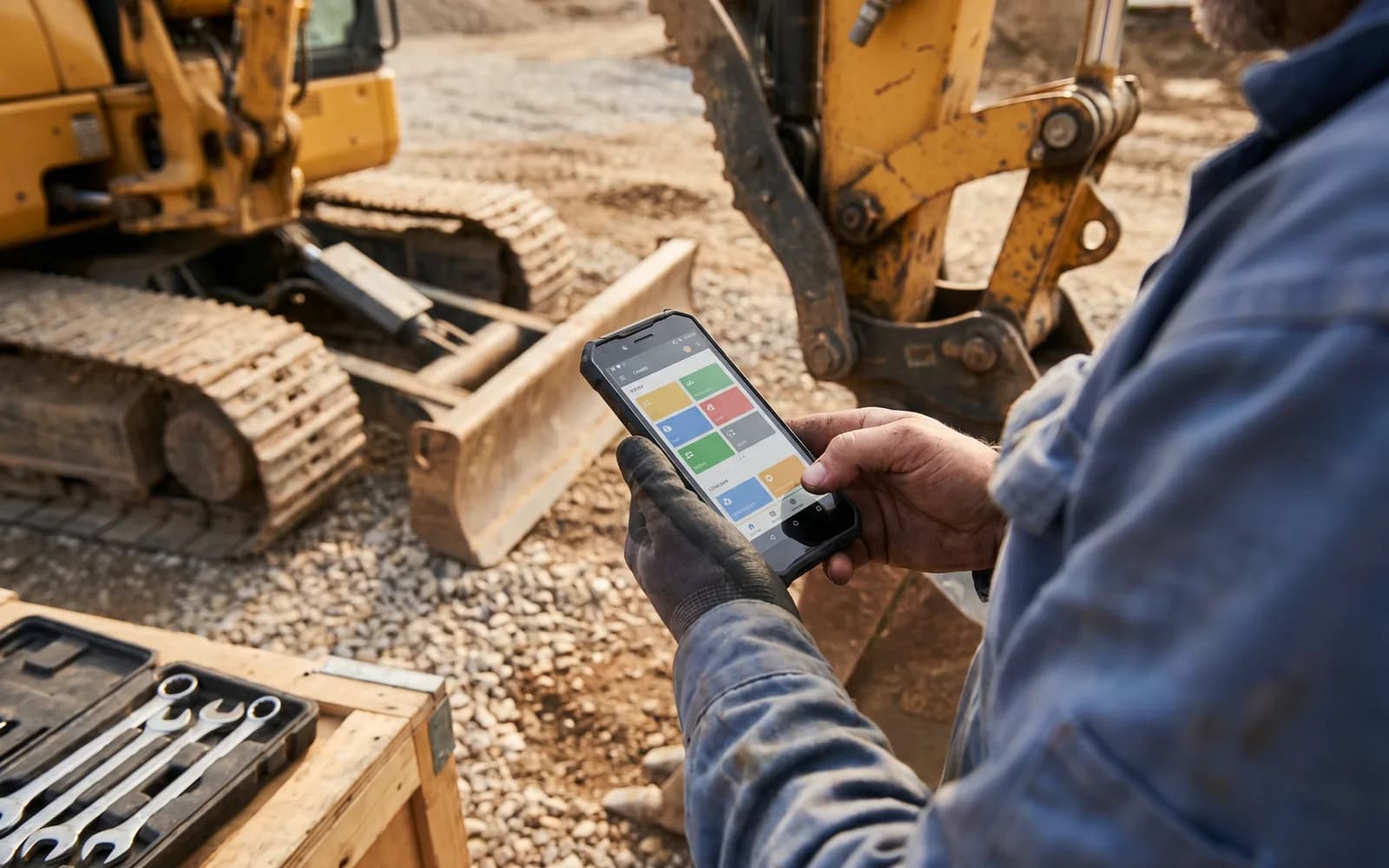
Instead of rigid forms, a single line of text: technicians type their usual shorthand gibberish, and a parser automatically translates it into clean records in the asset register.
INDUSTRY
Construction machinery / plant engineering
SERVICES
Custom Web App, AI & Automation, Workflow Integration
TIMEFRAME
2017 · 8 months
/01
The situation
A maker of heavy earth-moving machinery was losing valuable preventive-maintenance data. Field-service technicians often didn't submit their formal maintenance reports at all — leading to missing histories, unbilled component upgrades and unexpected failures at customer sites.
The technicians were highly qualified mechanical engineers who spent their days outdoors in harsh conditions. They noted their findings in an unofficial, handwritten shorthand system in small pocketbooks. They rejected complex enterprise apps for mobile asset management: operating deeply nested dropdown forms with greasy hands in a mud pit was simply impractical, they said.
/02
Our approach
We discarded the idea of rigid enterprise forms entirely. Instead, we developed a minimalist mobile web application built around a single, unstructured text-entry field. Technicians could type or dictate their findings exactly as they would have written them in their pocketbooks — with their usual mechanical shorthand and abbreviations.
As a two-person team, we built a customizable parser based on regular expressions. When a technician entered an abbreviated string — say “HYD-P-300-REPL-OK” — the backend automatically mapped the shorthand to the official components and work steps, converted the entry into a structured XML schema and updated the central asset database.
/03
The outcome
Reporting discipline for maintenance reports rose drastically within three months — from a small fraction to near-complete capture. Valuable experiential knowledge from the technicians was systematically recorded for the first time.
Because the application adapted to the physical reality of the work rather than the other way around, complete histories and cleaner billing cycles became possible — without a single technician having to give up their proven way of taking notes.
YOUR PROJECT