
CASE STUDY
IoT retrofit without replacing machines in a textile mill
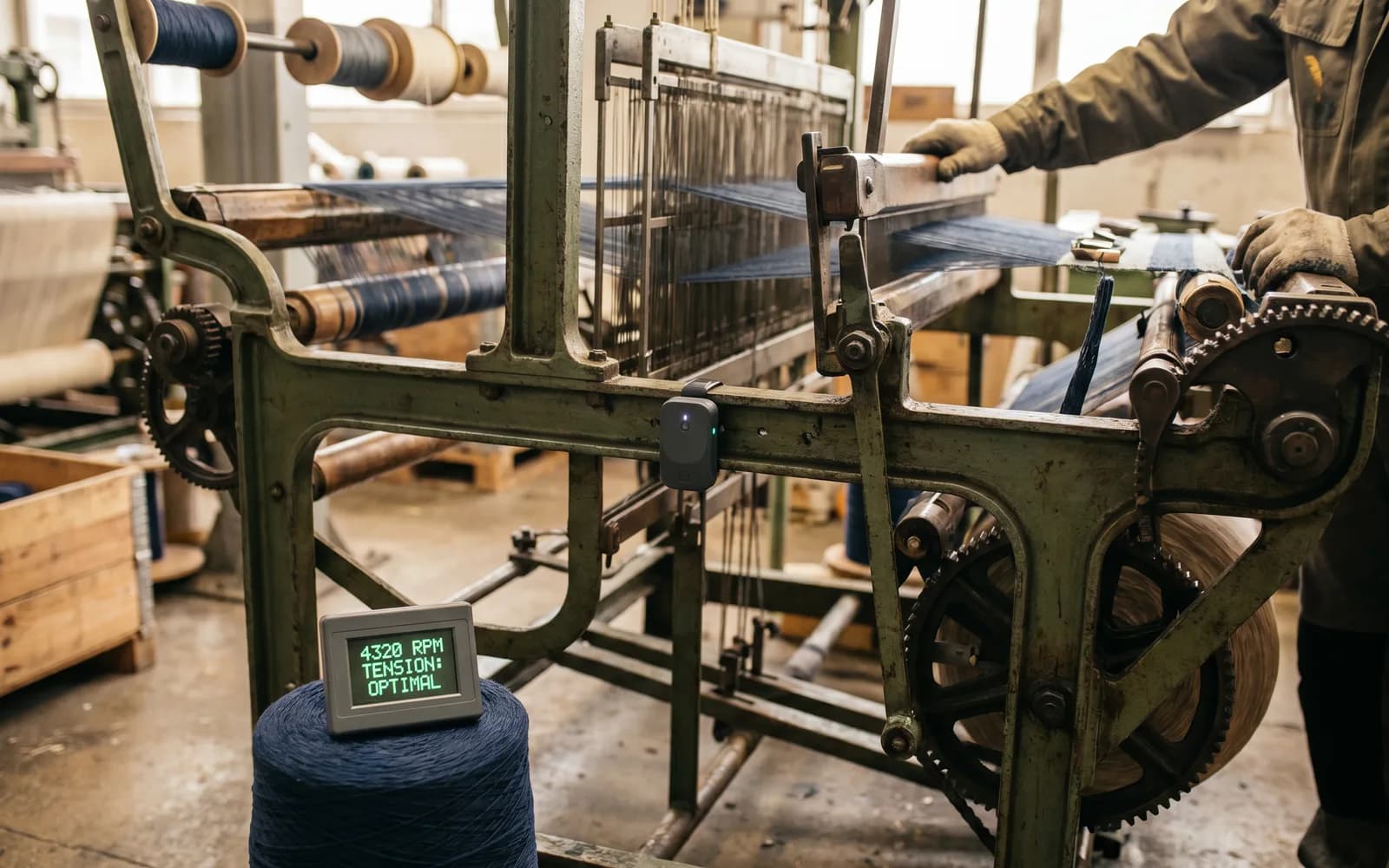
Mechanical looms from the 1980s read digitally without conversion: OEE metrics and fault alerts in real time — without changing a single move on the shop floor.
INDUSTRY
Textile production
SERVICES
IoT Retrofit, Cloud Deployment, Workflow Integration
TIMEFRAME
2021 · 9 months
/01
The situation
To hold its own in tough international price competition, a long-established textile mill needed real-time overall-equipment-effectiveness (OEE) metrics and automatic fault alerts. But its production ran entirely on purely mechanical industrial looms from the mid-1980s — machines with no digital interface at all.
The operators controlled the looms through experience: through tactile feedback, acoustic changes and manual levers. The obvious modernization path — replacing the analogue fleet with new digital machines — would have meant high investment, months of production downtime and retraining a well-drilled core workforce.
/02
Our approach
Instead of replacing the machines, we designed a non-invasive IoT telemetry layer that treats the old looms as valuable assets. Staff continued their familiar manual routines unchanged — the digital data capture ran unnoticed alongside.
As a two-person team, we retrofitted the looms with inexpensive, externally attached sensors: split-core current transformers on the motor supply lines for the current profile, and optical proximity sensors to count the shuttle cycles.
A local Raspberry Pi-based gateway cluster bundled the raw signals and converted them into real-time data streams that fed a web-based OEE dashboard in the office.
/03
The outcome
Within nine months, the mill gained end-to-end digital OEE capture and automatic fault alerts — at a fraction of the cost of replacing the machines.
Unplanned downtime fell noticeably as early as the first quarter, because maintenance could respond faster.
And all of this without any friction on the shop floor: the workforce worked as before, while robust operating data emerged in the background for the first time.
YOUR PROJECT